Historical Homes Studio by Sarah O' Fogarty


📍Ireland 🎬Film Friendly Places 📸Heritage Locations 📖Storytelling Exploring Irelands Castles, country houses, gardens, ruins and character filled locations through photograpy, history and storytelling.
How it all began...
Fogartys are said to be descendants of Milesius (Míl Espáine), a legendary figure in Irish history who was the said "King of Spain" linking my ancestors to ancient Spanish-Gaelic origin. Milesius was a Spanish king who was married to the daughter of an Egyptian Pharaoh, Scota, and sent his sons to colonize Ireland. The Gaelic Irish people are said to descend from his son Heber around 1000 bc. King Milesius is descended from a long line of Scythian kings with ancestors tracing back to Noahs son Japheth. King Milesius myth was treated as accurate history until the 19th century and is rooted in earlier pagan lore, according to a genetic link between Irish populations and people from the Basque region/Iberia, hinting at an ancient, pre-historic migration underlying the tale.
Among the sons of Míl Espáine in Ireland were (H)Éber Fionn, Érimón, Ír and Amergin. The traditional genealogies of Gaelic Ireland and Gaelic Scotland trace the ancestors of the Gaels back to one of the first three sons. Typically, the descendants of (H)Éber Fionn were prominent in Munster and it his his line that the Fogartys are on, the progeny of Ír, through his son Éber formed the bulk of Ulster and then offspring of Érimón were most powerful in Connacht, Leinster and parts of Ulster.
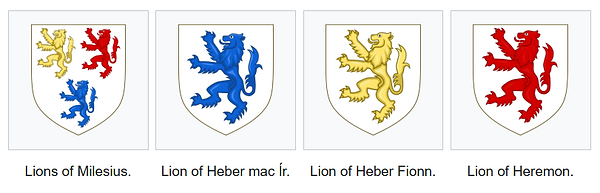
King Milesius of Spain bore three lions as his symbol. Each of the lions were borne by his progeny: Heber Fionn and Heremon (as well as their descendants) bore the gold and red lions respectively, while his grandson Heber mac Ír bore the blue lion. https://en.wikipedia.org/wiki/M%C3%ADl_Esp%C3%A1ine
The Fogarty tribes descendant from (H)eber Fionn son of King Milesius were associated with Dalcassian Septs and regarded as Dalcassian in origin. The Dalcassians Septs are a Gaelic Irish tribe, generally accepted by contemporary scholarship as being a branch of the Déisi Muman, that became a powerful group in Ireland and particuarly Tipperay during the 10th century. The Fogarty crest carries the gold lion representing descendents from (H)eber Fionn, son of King Milesius of Spain.
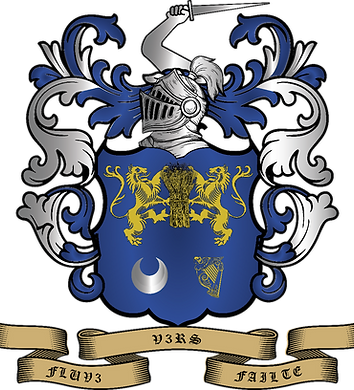
The Fogarty name has a crest and was said to have come into existence many years ago, probably as early as the 10th century. Prior to this, it is known that the Fogarty tribe probably had some form of proto-heraldry. I would like to believe that this was true.
The Fogarty tribe had such importance from this period onwards, that a significant piece of land in Tipperary had their name on it - it was called Eliogarty. Eliogarty is now the name of the barony of land of County Tipperary and we know this to be the beautiful town of Thurles today. Ely O’Fogarty Chieftancy reined over this mighty land for their future generations.
The Fogarty crest motto is 'Fleadh agus Fáilte' - Festivities and Welcome.
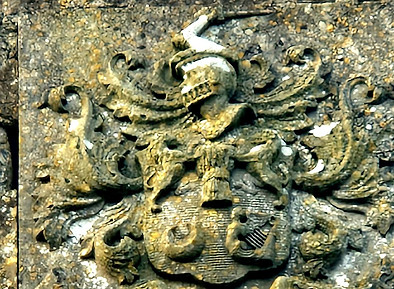
Fogarty Crest
Blue - Represents Loyalty and Truth
White - Peace & Sincerity
Gold - Generosity
Knights Helmet & Sword - Warrior Clan, ready to defend
Crescent Moon - One who has been enlightened & honoured by strength
Wheathsheaf - Plentiful
Harp - Harmony, Contemplation & Irish Culture
Lions - Courage & Strength - Descendants of King Milesius and his son (H)eber Fionn
On the ribbon - 'fluv3 - v3rs- failte' is an old heraldic style of text & digits translated mean 'flow, towards, welcome' so you could say 'A Place of Welcome'
Surviving magnicificent artifact such as The O’Fogarty Harp that dates from around 15th century has survived all this time. How truly incredible. It is currently standing tall in all its glory at the Tipperary County Library, The Source Arts Centre, Cathedral Street in Thurles, Co. Tipperary.
It is remarkable that we have this valuable piece of culture and heritage still to this day to proudly display to the world.
The harp has a very large low headed design measuring at its longest 92cm and accommodates 35 strings in total. At the upper end of the harps pillar four holes mark the place where a plate of gold was once attached. This plate, which is now missing unfortunately, is believed to have borne the following engraved words in Irish, “This is the harp of Cornelius O’ Fogarty“.
The O’Fogarty harp was owned and played by the gentleman harper Cornelius O’Fogarty (1661-1730) then resident at Castle Fogarty, County Tipperary and has remained in the ownership of his descendents ever since until recent years. It has since been sold. One day, this majestic castle may be up for sale again perhaps I will have the opportunity to buy it. I can always dream !
In the last four hundred years Castle Fogarty in Tipperary passed out of family ownership just once (until a few years ago for the 2nd time) and it was when Cromwell himself confiscated it in the 1650s . The O’Fogarty’s had to buy it back from one of his troopers and successfully did so. This story filled castle survived the turmoil of Irish history in the same Gaelic family hands since the middle ages.
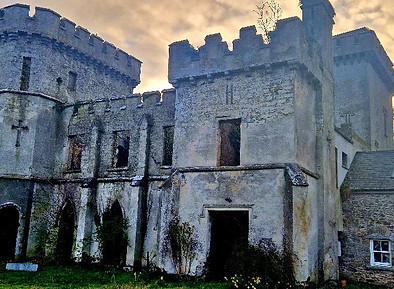
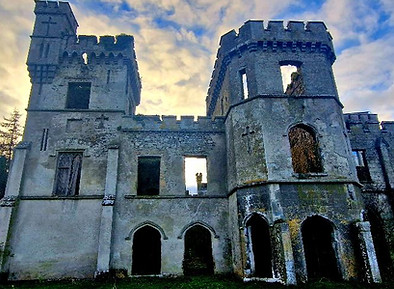
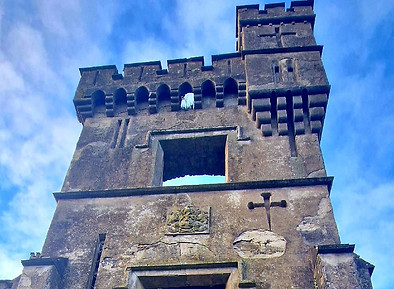
The seat of the O’Fogarty clan since medieval times was originally built as a stone fortress at Ballycahill, between Thurles and Cashel. It was later rebuilt as a large house in the Georgian era, before being transformed in the 1840s into a gothic revival castle with five elegant castellated towers and twenty bedrooms.
Today, the Neo-Gothic ruin is still an attractive building. Listed for preservation, it is described by the Buildings of Ireland Website as being a well built structure with good detailing seen in the string courses, buttresses and imitation loops. Sadly it concludes that the castle “presents a gaunt ruin in the landscape today.'
The Fogarty Chalice of 1641 that was splendid on display at the Rock of Cashel, Tipperary.
Fogarty (Otway) Castle, Templederry, Nenagh in Tipperary combines a medieval tower house originally part of Cloghonane castle—with an 18th-century Queen Anne manor built circa 1750. The tower, likely a Fogarty structure appropriated by the Otway family after lands were granted to Colonel John Otway in 1666, featured defensive elements such as castellations, machicolations, and a turret, while the attached house was a seven-bay two-storey structure over a half-basement with a pedimented breakfront and limestone detailing.
The Medival tower house component of Castle Otway originates from Cloghonan Castle, a late medieval-style fortified structure constructed circa 1600 in County Tipperary, Ireland. This tower exemplifies the Gaelic Irish architectural tradition of tower houses, which proliferated from the 15th to early 17th centuries as defensive residences for local lords amid ongoing conflicts with English forces and rival clans. Typically square in plan with thick stone walls, such keeps provided elevated living quarters, storage, and defensive vantage points, often featuring battlements, murder holes, and narrow windows for archery.
Cloghonan's design adhered to this pattern, forming a robust square keep approximately 50 feet in height. Local historical accounts attribute the original construction to the Fogarty family, a Gaelic sept dominant in the Ely O'Carroll territory encompassing much of northern Tipperary during the Tudor period. The Fogartys, as hereditary erenaghs or lords, utilized such towers to safeguard against incursions, including those during the Nine Years' War (1594–1603), when native Irish resistance peaked before the eventual Stuart settlement. No precise builder or inscription survives, but the structure's positioning on elevated ground near Templederry optimized visibility over surrounding boglands and river valleys, enhancing its strategic utility.
By the mid-17th century, following the Cromwellian land confiscations of 1649–1653, Cloghonan was granted to Anglo-Irish settler Captain John Otway in 1665 as part of broader redistributions favoring Protestant loyalists.The tower thus transitioned from Gaelic ownership to integration within an English-style estate, though its core medieval fabric persisted amid 18th-century attachments to the manor house and subsequent modifications, preserving remnants of the original walls and form. This evolution underscores the hybrid nature of Irish country seats, blending indigenous defensive architecture with colonial manor developments.https://grokipedia.com/page/castle_otway
Fogartys are also known to have built and owned Killahara Castle, also in North Tipperary. The history of Killahara Castle in many respects reflects the history of the country from 1550. The disruption of a country still largely under ancient Brehon laws, the relative silence of the 18th century, the turmoil of the 19th, ongoing struggle for land, power and cultural dominance, the devastation wrought by Malthusian economics, the Great Famine, pastoralisation mass forced emigration, the Land War, the demise of an aristocracy and the War of Independence - all are represented in the story of this Castle.
Local belief is that Killahara Castle was built by the Fogarty clan in around 1400. However, archeological experts say that it is more likely to have been built in the mid 1500s. That is near the end of the era in which castles of its kind, ‘tower house’ castles, were built . The finer detailing on the stone work (e.g. hammer dressing on the quoins, fine pecking and drafted margins), is typical of the style of stonework favoured towards the end of the tower house castle era.
A castle like Killahara was primarily a family dwelling. It was a place where friends and extended family of a powerful chief could be entertained. There would have been large fires going all the time and in the old tradition, the chiefs would have prided themselves on their hospitality. Visitors would have been generously fed and watered. Travelling musicians and entertainers of all sorts would have been welcomed. Just like the motto of the Fogarty crest - Festivities and Welcome.
Behind the altar on the north wall of the chancel of Holycross Abbey is the niche containing the O’Fogarty tomb. This was the position within abbeys usually reserved for the founder’s tomb but King Dónal Mór O’Briain, the founder, is buried in Limerick Cathedral. The O’Fogartys were given this prominent place in the Abbey probably because it was built on their territory and the O’Briens were related through marriage to the clan. King Dónal Mór’s mother was Raghnailt O’Fogarty.
Behind the altar on the north wall of the chancel of Holycross Abbey is the niche containing the O’Fogarty tomb. This was the position within abbeys usually reserved for the founder’s tomb but King Dónal Mór O’Briain, the founder, is buried in Limerick Cathedral. The O’Fogartys were given this prominent place in the Abbey probably because it was built on their territory and the O’Briens were related through marriage to the clan. King Dónal Mór’s mother was Raghnailt O’Fogarty.
The top slab of the tomb has a lovely gothic inscription in Latin that is quite eroded. It records that Donagh O’Fogarty and his wife Helen Purcell are buried here. Donagh was the O’Fogarty Chief who was killed at the Battle of Latteragh on the south side of the Devil’s BIt in 1583 AD during the doomed Desmond Rebellion. His internment here would support the idea that this was the traditional burial place of the O’Fogarty chiefs since earlier times. It was at this time that the frontal slab was also carved. It shows a crucifixion scene with Mary on the left of the cross and St. John, now missing, on the right. This kind of scene is found in traditional christian art more than on medieval carvings and it connects the O’Fogartys to their ancient Celtic roots.
It was onto this tomb that the ‘corrosive drop’ fell following the curse of ‘The Good Woman”. It is believed that the Good Woman was Queen Eleanor, wife of Henry II. She had cursed the Clan because they had murdered her son who was collecting Peter’s Pence in Ireland. He was murdered in the Ballycahill area and his body was buried where he fell. She said a corrosive drop would fall on the tomb of the O’Fogartys and that they ‘would grow like swine and wither away like bracken for the want of mail heirs’. A slab with a hollow on its surface supposedly caused by the ‘braon ailse’ was on the Abbey’s high altar until the restoration in the 1970‘s. It is now locked away in the ruined part of the Abbey. Hopefully it will be put on display for public view before long.
The queen’s curse had little effect because the O’Fogarty title lasted for another 600 years or more.The last O’Fogarty chief in the Irish tradition, Tadhg, was buried here in 1698. Tadhg had moved the seat of the clan from Drom to Garranroe, Ballycahill in 1666.
His son Cornelius was probably the best known historically. He was a noted harpist and his harp can still be seen in the Source Library, Thurles. He fought in the Battle of the Boyne, the Siege of Limerick and the Battle of Aughrim during The War of The Two Kings, William of Orange and James II. Cornelius was a captain in King James’ army and returned to Garranroe, later named Castlefogarty, after that war. He died in 1730. He was friendly with the last monk attached to the Abbey, Fr. Edmund Cormack. He left him £5 in his will. The last male heir was James Fogarty MD. He was responsible for the changingthe placename Garranroe to Castlefogarty. He died at sea in 1788. https://www.tipperarylive.ie/news/local-news/140386/The-O-Fogarty-Tomb-at-Holycross.html


Fogarty Castle
Fogarty Castle
Fogarty Castle
O'Fogarty Harp
Killahara Castle